Kundli matching and Guna Milan: what the 36 points settle
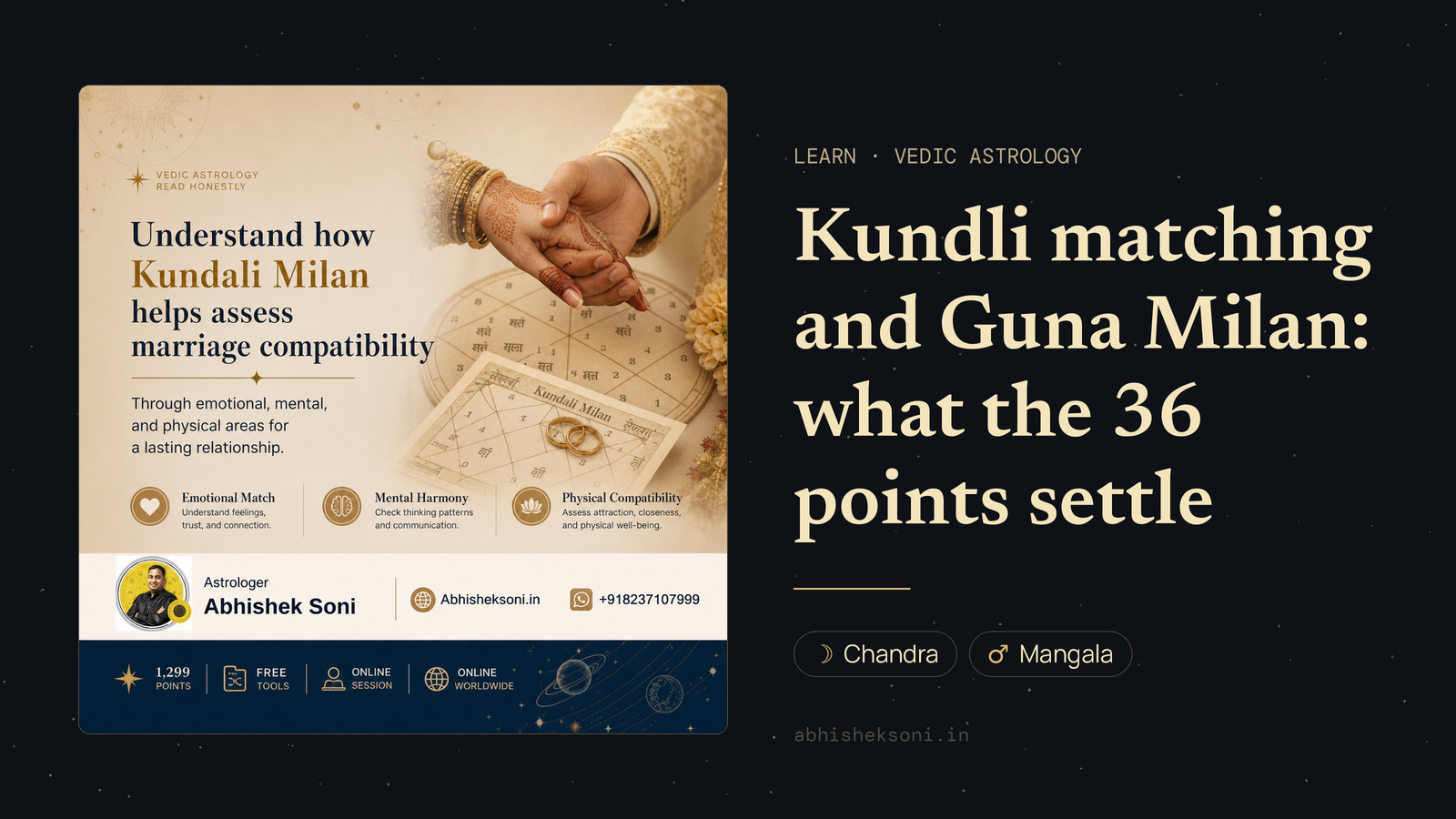
Kundli matching gives a score out of 36 by comparing the Moon's position in two charts. Eighteen and above is the conventional threshold for a match being considered acceptable. That is the whole of what the number is: a first screen built on one planet, useful for narrowing a field, and not a verdict on whether two people should marry.
You can run it for free on this site. The free Guna Milan calculator needs both birth details and no account. What follows is what to do with the number once you have it.
What the score is actually measuring
Guna Milan compares eight things between the two charts, and each is worth a different number of points, adding to thirty six. In plain words the eight are: mutual attraction, the balance of dominance between the two people, temperament, the meeting of minds, the natural friendliness of the two Moon signs, physical and health compatibility, the general wellbeing of the union, and the prospects for children.
Every one of those comparisons is made from the Moon: the sign it is in and the nakshatra it occupies. Nothing else in either chart is consulted. Read them as eight separate observations rather than one number. Two matches can both score 24 and be describing completely different situations, and the useful information is in which of the eight are weak, not in the total.
That single fact explains most of what is right and wrong about the method. The Moon in this tradition stands for the mind, for how a person feels and reacts, and comparing two minds is a sensible thing to do before a marriage. But a marriage is not only two minds, and the score does not look at the 7th house in either chart, at Venus, at Saturn, at Mars, at which long planetary period, or mahadasha, either person is running, or at whether the two families can be in a room together.
What the score bands conventionally mean
The convention in wide use across India is simple. Below 18 out of 36 is generally treated as too weak to proceed on matching alone. Eighteen and above is treated as acceptable. Above 25 is considered a strong match, and a score in the low thirties is uncommon. The threshold is a convention, not a law of nature: a score near the top is not a promise, and a score below 18 is a reason to look at both charts properly, not a reason to stop the conversation.
Why scores collapse below 18
A low score usually comes from one of two places, and both are worth understanding rather than fearing.
The largest block of points, eight of the thirty six, is awarded on a health and constitution grouping derived from the nakshatra. There are only three groups. If both charts fall in the same group, all eight points are lost at once. Families are often told this as a serious problem in itself.
The next largest block, seven points, is awarded on the distance between the two Moon signs. Certain distances score zero, and again the whole block goes together.
So a couple can lose fifteen of thirty six points on two technicalities and land at twenty one, or lose one of them and land near the threshold, without anything having been said about the two people at all. This is why a number just under eighteen should start a conversation and not end one. Any competent astrologer will tell you that the classical texts themselves discuss exceptions to both of these, and that they were never meant to be applied as a pass or fail gate.
Mangal Dosha, separately
Mangal Dosha is not part of the thirty six points. It is checked separately, by looking at where Mars sits in each chart, and it is reported far more often than it is read carefully.
Two honest things about it. It is common, which by itself should tell you it cannot be the disaster it is described as. And the tradition has always held that where both charts carry it, the matter is considered settled between them. Different traditions also count it from different reference points, the rising sign, the Moon or Venus, which is why one astrologer finds it and another does not in the same chart, and the tradition provides for it being cancelled or reduced by several conditions that a proper check looks for before the word is ever said to a family. If someone has told you a match is impossible because of Mars, ask them to show you both charts and explain what specifically they are reading.
What a score cannot do
I would rather be plain about this than sell a number.
A score cannot tell you whether two people will be happy. It cannot tell you whether a marriage will last. It is calculated from the Moon alone, so two matches with an identical thirty two can have completely different 7th houses, and the 7th house is where the actual marriage lives. See an empty 7th house for how that part of a chart is read. It does not look at Venus or Jupiter, at the 2nd house for family life, the 4th for domestic peace or the 5th for children, or at whether the period either person is running supports a marriage now. The score is not wrong. It is answering a narrower question than the family thinks it is answering.
It also depends entirely on birth times being right. The nakshatra changes roughly every day, so the Moon's nakshatra is usually safe, but if either birth time is off by hours the sign itself can change and the score with it.
And a score has no view at all on the things that actually break marriages: money, drinking, in laws, distance, a job that swallows a person, and two people who never learned to say a difficult thing to each other calmly.
A placement is not a description of a person
An empty 7th house does not mean an empty marriage. Venus in a house does not prove that a partner is loving, and Mars in a house does not prove that somebody is quarrelsome. These are symbols read within a tradition, not observations of the person you are considering marrying.
So a chart should never be used to label someone unfaithful, infertile, mentally unwell or unsuitable. If a concern is about actual behaviour, discuss the behaviour directly. Astrology cannot substitute for consent, conversation, medical advice or an honest look at whether someone is safe to be with.
How to use it sensibly
Run the free tool for a first pass. If the score is comfortable, take it as one small piece of reassurance and go on with the ordinary work of finding out who the person is.
If the score is low, find out which block of points was lost and why. That takes two minutes for anyone who knows the method, and it very often turns a frightening number into a technicality with a known exception.
If the match is serious, have both charts read together properly: the 7th house and its lord in each, Venus and Jupiter, Mars in both charts including the conditions that cancel it, and the timing each person is running. Then say plainly which parts agree and which do not. That produces something a family can use: not a pass or a fail, but a description of where the two charts support each other and where they will need patience. It is a different piece of work from a score, and it is what a reading covers.
If either birth time is uncertain, say so, and ask which parts of the reading would survive the time being wrong. A careful reader explains that uncertainty rather than quietly filling an unknown time with noon and presenting a house-based conclusion as certain.
The conversations a score cannot replace
Talk about where you want to live, how you handle money and whose work matters how much. Discuss children, caring for parents, religion, family involvement and time together. Ask how disagreements will be handled.
An example helps. Two people may both want to marry and still disagree about moving cities for work. That is a real decision with practical consequences, and no chart settles whose career comes first. A conversation about options, costs and responsibilities is the useful next step. Refusing to discuss important decisions is information a matching score cannot give you.
Families who attach weight to matching can keep that tradition and still leave the decision with the adults involved. Nobody should be pressured to marry, reject a partner or buy a remedy because of a score. If a consultation turns into an escalating pitch for mandatory remedies, pause and ask whether it is still answering your question.
And if a family is using the number to say no to something they had already decided against, no astrologer can help with that. It is worth naming when it is happening.
Questions people ask
Is a score below 18 a reason to refuse a match?
Not on its own. The two largest blocks of points, worth eight and seven, are awarded on technical groupings that go to zero all at once, so a couple can lose fifteen points without anything being said about their compatibility as people. Find out which block was lost before treating the number as an answer.
Is a score of 30 or more a guarantee of a happy marriage?
No. A high score means two Moons that sit well together, which is a genuine and pleasant thing. It says nothing about the 7th house in either chart, about timing, or about the practical circumstances that decide most marriages.
Can kundli matching predict divorce?
No. Tradition can indicate that the marriage area in a chart is under strain and that certain periods are harder. It cannot predict how two people will conduct themselves. Any astrologer who tells a family a marriage will fail is going well past what the method supports.
Is matching still worth doing for a love marriage?
It can be, though the question changes. When two people have already chosen each other, the useful output is not a score but a description: where the two charts pull in different directions, which years are likely to be demanding, and what each of them will need to be patient about. Done that way it is preparation rather than permission.
Do I need exact birth times for kundli matching?
For the score itself, approximate times are usually survivable, because the Moon stays in a nakshatra for around a day. For anything beyond the score, including the 7th house in either chart, you need accurate times. If a time is a guess, say so at the start rather than letting a reading be built on it.
Comparing two people needs two clearly identified charts and the other person's permission to use their birth details. Asking about your own marriage timing is a different question and needs neither; that one is covered in when will I get married.
Sources
Brihat Parashara Hora Shastra, chapters 3 to 10, Sanskrit Documents, for the traditional planet, sign and house vocabulary. A classical text documents the terms; it does not validate the interpretations.
Hindu astrology, Wikipedia
- Brihat Parashara Hora Shastra, R. Santhanam's English translation, Internet Archive
- Chandra, Wikipedia