The twelve bhavas (houses) of a Vedic birth chart
Also in: हिन्दी
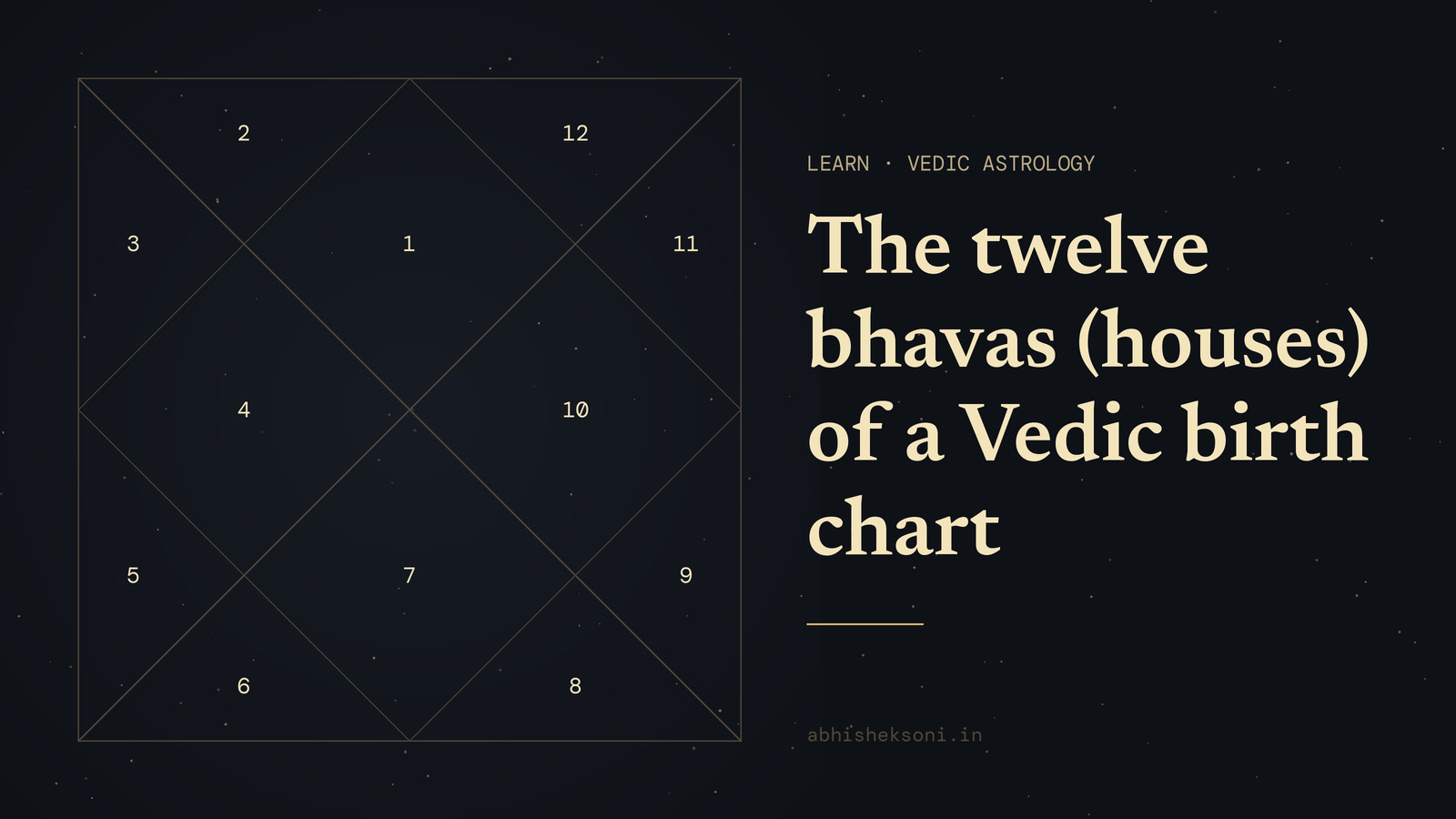
A Vedic birth chart has twelve bhavas (houses). In the classical grouping, houses 1, 4, 7 and 10 are kendra houses; 1, 5 and 9 are trikona houses; 6, 8 and 12 are dusthana houses; 3, 6, 10 and 11 are upachaya houses. Each page gives the house's significations and its karaka.
What is a bhava?
A bhava is a house: one of the twelve divisions of a birth chart, each standing for an area of life. The 1st house is the self and the body, the 4th is mother and home, the 7th is marriage and partners, the 10th is work and standing in the world. The house a graha sits in tells you which part of life it acts on; the sign on the house tells you how. Some houses share a theme from two sides, like the 2nd and the 11th: money that is kept, and money that comes in.
How are the houses of a kundli worked out?
The houses start from the lagna, the sign rising on the eastern horizon at the moment and place of birth. That sign becomes the 1st house, the next sign the 2nd, and so on round the chart. The charts on this site use whole-sign houses, the classical Parashari method, so each house is exactly one rashi. The rising sign changes about every two hours, so the birth time decides which sign becomes the 1st house, and with it the house every graha falls in.
What does each house signify?
Each house carries a classical list of significations, and a karaka, a graha that naturally stands for the same things. The table gives the short list and the group each house belongs to. Each house opens its own page.
| House | Signifies | Group |
|---|---|---|
| 1st house | self, body, personality, head, appearance, vitality | Kendra, Trikona |
| 2nd house | family, wealth, speech, food, face, early childhood | |
| 3rd house | siblings, courage, communication, short travel, hands, skills | Upachaya |
| 4th house | mother, home, vehicles, education, comfort, real estate, heart | Kendra |
| 5th house | children, intelligence, creativity, romance, purva punya, speculation | Trikona |
| 6th house | enemies, debt, disease, service, litigation, daily routine | Dusthana, Upachaya |
| 7th house | spouse, partnership, business, public, trade, foreign trips | Kendra |
| 8th house | longevity, transformation, occult, inheritance, sudden events, research | Dusthana |
| 9th house | father, dharma, fortune, higher learning, long travel, religion | Trikona |
| 10th house | career, status, authority, public role, achievements, father's longevity | Kendra, Upachaya |
| 11th house | gains, elder siblings, friends, fulfillment of desires, networks | Upachaya |
| 12th house | losses, foreign land, isolation, moksha, expenditure, bed pleasures | Dusthana |
What are kendra, trikona, dusthana and upachaya houses?
The texts group the houses. The kendras (1, 4, 7 and 10) are the angles, the pillars of a chart, and grahas there act strongly and visibly. The trikonas (1, 5 and 9) are the houses of merit and fortune. The dusthanas (6, 8 and 12) are the difficult houses, of illness, sudden change and loss, though a graha there is not doomed: the 6th is also where you beat competition, the 12th where you rest and let go. The upachaya houses (3, 6, 10 and 11) are the houses of growth, where things improve with time and effort.
Is an empty house in a kundli bad?
No. Nine grahas cannot fill twelve houses, so every chart has at least three empty ones. An empty house is read through its lord, the graha that rules the sign on it, and through any graha that aspects it. An empty 7th house does not mean no marriage, and an empty 10th does not mean no career. If a house matters to your question, its lord's sign, house and dasha are where the answer is.
- 1st House (Tanu Bhava) Tanu · 1. House of Self · तनुbody, appearance, temperament, vitality, the head
- 2nd House (Dhana Bhava) Dhana · 2. House of Wealth · धनaccumulated wealth, family, speech, food, right eye
- 3rd House (Sahaja Bhava) Sahaja · 3. House of Courage · सहजyounger siblings, courage, short travel, hands, communication
- 4th House (Sukha Bhava) Sukha · 4. House of Happiness · सुखmother, home, land, vehicles, education, chest
- 5th House (Putra Bhava) Putra · 5. House of Progeny · पुत्रchildren, intellect, purva punya, mantra, speculation
- 6th House (Ari Bhava) Ari · 6. House of Adversity · अरिenemies, disease, debt, litigation, service, maternal kin
- 7th House (Yuvati Bhava) Yuvati · 7. House of Union · युवतिspouse, partnership, trade, public dealings, desire
- 8th House (Randhra Bhava) Randhra · 8. House of Transformation · रन्ध्रlongevity, sudden events, occult, inheritance, chronic ailment
- 9th House (Dharma Bhava) Dharma · 9. House of Fortune · धर्मfather, guru, dharma, pilgrimage, higher learning, luck
- 10th House (Karma Bhava) Karma · 10. House of Action · कर्मcareer, status, authority, public standing, action in the world
- 11th House (Labha Bhava) Labha · 11. House of Gains · लाभincome, gains, elder siblings, networks, fulfilment of desire
- 12th House (Vyaya Bhava) Vyaya · 12. House of Loss · व्ययexpenditure, foreign lands, isolation, moksha, bed pleasures, left eye